Why Buying New Machines Alone Doesn’t Guarantee Growth
Is Your Manufacturing Business Growing, But Operational Challenges Are Growing Too?
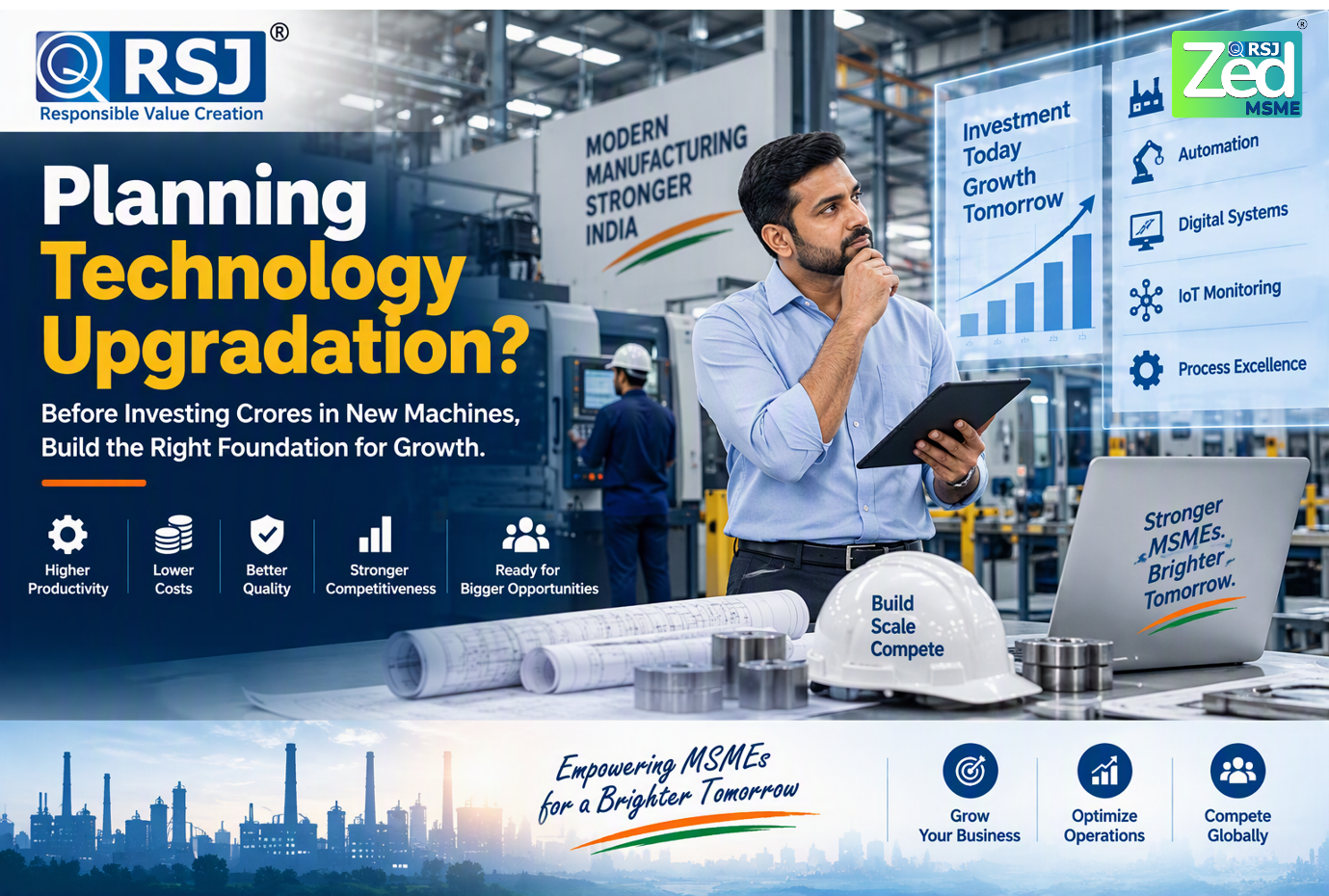
If you are a manufacturing MSME with an annual turnover of ₹10 Crore or more, and you’re planning to invest in new machinery, automation, CNC machines, robotics, ERP software, or digital manufacturing technologies, then this article is for you.
Many growing manufacturers reach a point where business opportunities are increasing, customer expectations are rising, and expansion seems like the next logical step. To support this growth, businesses often start exploring:
- New machinery purchases
- Production line upgrades
- Factory automation
- Industry 4.0 technologies
- Capacity expansion projects
- Digital transformation initiatives
However, before investing lakhs or crores in technology, there’s one important question every MSME should ask:
Will new technology alone solve the challenges holding the business back? For many manufacturers, the answer is surprisingly “No.”
Do These Challenges Sound Familiar?
Many manufacturing MSMEs experience these issues just before or during expansion:
✅ Production capacity is increasing, but systems are not ready
✅ High rejection and rework costs are reducing profitability
✅ Difficulty qualifying for larger customers and OEMs
✅ Operational inefficiencies are reducing machine utilization
✅ Lack of standardized processes is limiting scalability
✅ Customer complaints continue despite investments in equipment
✅ Productivity improvements are slower than expected
✅ Departments operate in silos with limited coordination
If your business is facing one or more of these challenges, you are not alone.
In many cases, the problem is not the machinery itself. The real issue lies in the processes, systems, workforce capabilities, and operational practices surrounding the technology.
Technology Is a Multiplier, Not a Solution
India’s manufacturing MSMEs are increasingly investing in CNC machines, automation systems, robotics, ERP software, IoT-based monitoring, and advanced production technologies.
The goal is simple:
- Higher productivity
- Lower manufacturing costs
- Better product quality
- Faster deliveries
- Increased competitiveness
However, many businesses discover that even after investing significant amounts in technology, the expected benefits never fully materialize.
The reason?
Technology does not transform a business on its own. It amplifies the effectiveness of existing systems, processes, and people.
If operational foundations are weak, technology often exposes those weaknesses instead of eliminating them.
Let’s explore the most common mistakes MSMEs make during technology upgradation.
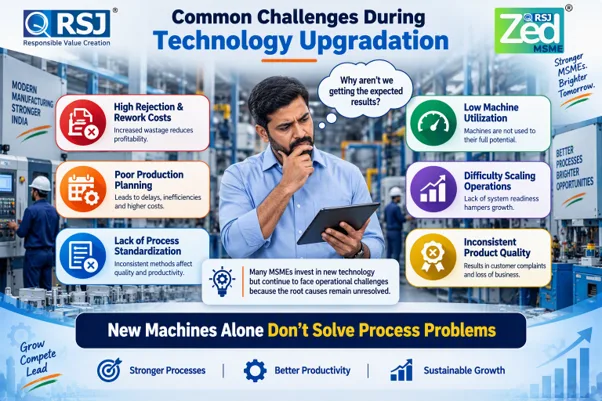
Mistake #1: Buying Equipment Before Identifying Root Causes
Many MSMEs assume that low productivity is caused by outdated machinery.
As a result, they invest in new equipment without first understanding the actual bottlenecks affecting performance.
The Real Problem May Be:
- Poor production planning
- Excessive setup and changeover times
- High material wastage
- Lack of preventive maintenance
- Untrained operators
- Weak quality control processes
- Unclear responsibilities across departments
A ₹1 crore machine cannot solve process-related issues.
What Successful MSMEs Do
Before investing, they assess:
✅ Machine utilization
✅ Production losses
✅ Rejection rates
✅ Downtime causes
✅ Process inefficiencies
✅ Capacity constraints
Technology is used to solve identified problems, not assumed ones.
Mistake #2: Ignoring Workforce Training
Installing advanced technology without training employees is one of the most expensive mistakes manufacturers make.
Many businesses purchase sophisticated equipment but continue operating it using traditional methods.
Common Consequences
- Frequent operational errors
- Lower productivity than expected
- Increased machine downtime
- Poor quality output
- Safety concerns
- Underutilization of machine capabilities
Best Practice
Create a structured training program covering:
✅ Machine operation
✅ Safety practices
✅ Quality requirements
✅ Preventive maintenance
✅ Troubleshooting techniques
✅ Performance monitoring
Remember:
A machine creates value only when the workforce knows how to maximize its capabilities.
Mistake #3: Focusing on Machinery Instead of Processes
Some MSMEs invest heavily in machines while continuing to run outdated business processes.
This creates a modern machine operating inside an inefficient system.
Common Issues
- Lack of Standard Operating Procedures (SOPs)
- No process documentation
- Weak inventory management
- Limited production visibility
- Manual decision-making
- Inconsistent workplace practices
Better Approach
Technology investments should be supported by:
✅ Process standardization
✅ Operational controls
✅ Quality systems
✅ Performance measurement
✅ Continuous improvement practices
Mistake #4: Underestimating Integration Challenges
Modern manufacturing technologies rarely work in isolation.
They often need to integrate with:
- Existing production lines
- ERP systems
- Inventory management software
- Quality management systems
- Maintenance systems
- Reporting dashboards
What Happens When Integration Is Ignored?
- Data silos
- Duplicate work
- Delayed implementation
- Reduced visibility
- Lower returns on investment
Recommendation
Develop a detailed implementation roadmap before purchasing equipment.
Technology should strengthen business operations, not create additional complexity.
Mistake #5: Not Measuring Return on Investment (ROI)
Technology upgradation should be viewed as a strategic business investment.
Unfortunately, many MSMEs struggle to answer questions such as:
- How much did productivity improve?
- How much wastage was reduced?
- How much downtime was eliminated?
- How much profitability increased?
- How much customer satisfaction improved?
Without measurement, improvement becomes difficult to validate.
Track Key Metrics Such As:
✅ Production output
✅ Machine utilization
✅ Rejection rate
✅ Energy consumption
✅ Productivity per employee
✅ Order fulfilment performance
✅ Customer complaints
What gets measured gets improved.
Mistake #6: Ignoring Quality Improvement
Many manufacturers upgrade technology to increase capacity but overlook quality systems.
As production volumes increase, quality problems can also grow if systems are weak.
Potential Risks
- Increased customer complaints
- Higher rejection rates
- Increased rework costs
- Product returns
- Loss of customer confidence
High-Performing Manufacturers Focus On
✅ Quality management systems
✅ Inspection controls
✅ Process monitoring
✅ Traceability mechanisms
✅ Continuous quality improvement
Growth without quality often creates bigger challenges than growth itself.
Mistake #7: Expanding Too Fast
Technology upgradation creates excitement.
Many businesses immediately increase production volumes without validating operational readiness.
Typical Outcomes
- Delivery delays
- Inventory mismatches
- Resource shortages
- Increased defects
- Financial stress
- Customer dissatisfaction
Recommended Approach
Scale gradually while monitoring:
✅ Productivity
✅ Quality
✅ Delivery performance
✅ Workforce capability
✅ Customer satisfaction
Sustainable growth is always better than uncontrolled growth.
Mistake #8: Missing to utilize available Government Support
Many MSMEs invest in technology without exploring available support mechanisms.
As a result, they may miss opportunities that could significantly reduce investment costs.
Areas Often Overlooked
- Technology upgradation support schemes
- State government incentives
- MSME support programs
- Productivity improvement initiatives
- ZED Certification benefits
A lack of awareness can result in missed financial and operational advantages.
Mistake #9: Treating Technology as a One-Time Project
Technology upgradation is not a one-time activity.
Markets evolve.
Customer expectations change.
Competition increases.
Regulatory requirements become more demanding.
The most successful MSMEs treat improvement as an ongoing journey.
They Regularly Review
✅ Productivity performance
✅ Process efficiency
✅ Quality performance
✅ Resource utilization
✅ Customer expectations
✅ Improvement opportunities
Continuous improvement creates long-term competitive advantage.
Are These Challenges Limiting Your Business Growth?
Even after investing in technology, many manufacturing MSMEs continue to struggle with:
- Low productivity
- High wastage
- Frequent quality issues
- Rising operational costs
- Difficulty scaling operations
- Limited readiness for large customers and exports
- Inconsistent business performance
In such cases, the challenge may not be technology.
The challenge may be a lack of operational excellence, standardized systems, and structured improvement practices.
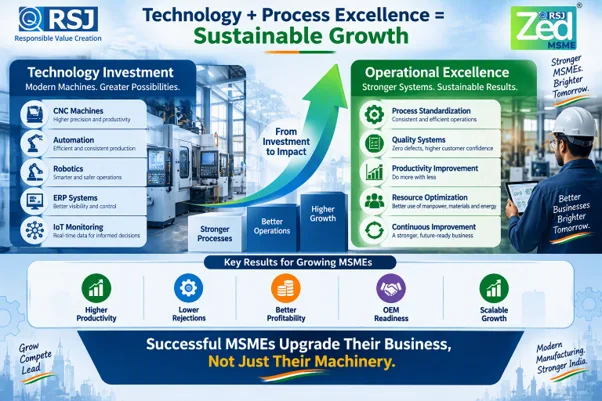
How ZED Helps MSMEs During Technology Upgradation
Technology investments generate better results when supported by strong business foundations.
The Zero Defect Zero Effect (ZED) framework helps MSMEs strengthen critical operational areas such as:
✅ Manufacturing processes
✅ Productivity management
✅ Resource utilization
✅ Quality systems
✅ Operational excellence
✅ Waste reduction
✅ Continuous improvement practices
✅ Business credibility
✅ Growth readiness
The objective is simple:
Create a stronger business foundation so that technology investments deliver maximum returns.
Technology can accelerate business growth, but technology alone does not create successful manufacturing businesses.
The most successful MSMEs understand that sustainable growth requires:
- Strong processes
- Skilled people
- Quality systems
- Operational discipline
- Continuous improvement
Before investing in your next machine, automation project, or factory expansion initiative, ask yourself:
“Are We Upgrading Our Technology, or Are We Upgrading Our Business?”
The answer could determine whether your investment becomes a long-term competitive advantage or an expensive missed opportunity.
Planning a Technology Upgrade?
If your manufacturing MSME has a turnover of ₹10 Crore+ and is planning capacity expansion, automation, machinery modernization, or digital transformation, now is the right time to evaluate whether your processes and systems are ready to support that growth.
Get Free ZED Facilitation Support
Our experts can help you understand how ZED can strengthen operational excellence, improve productivity, reduce wastage, and maximize returns from technology investments.
Stronger Processes. Better Productivity. Sustainable Growth.

Connect with RSJ Experts Today. 🚀