Universal Global Trade & Industrial Excellence | Operational Advisory by RSJ Inspection Services (QCI-Empaneled Assessment Agency)
THE STRATEGIC HOOK & REALITY CHECK:
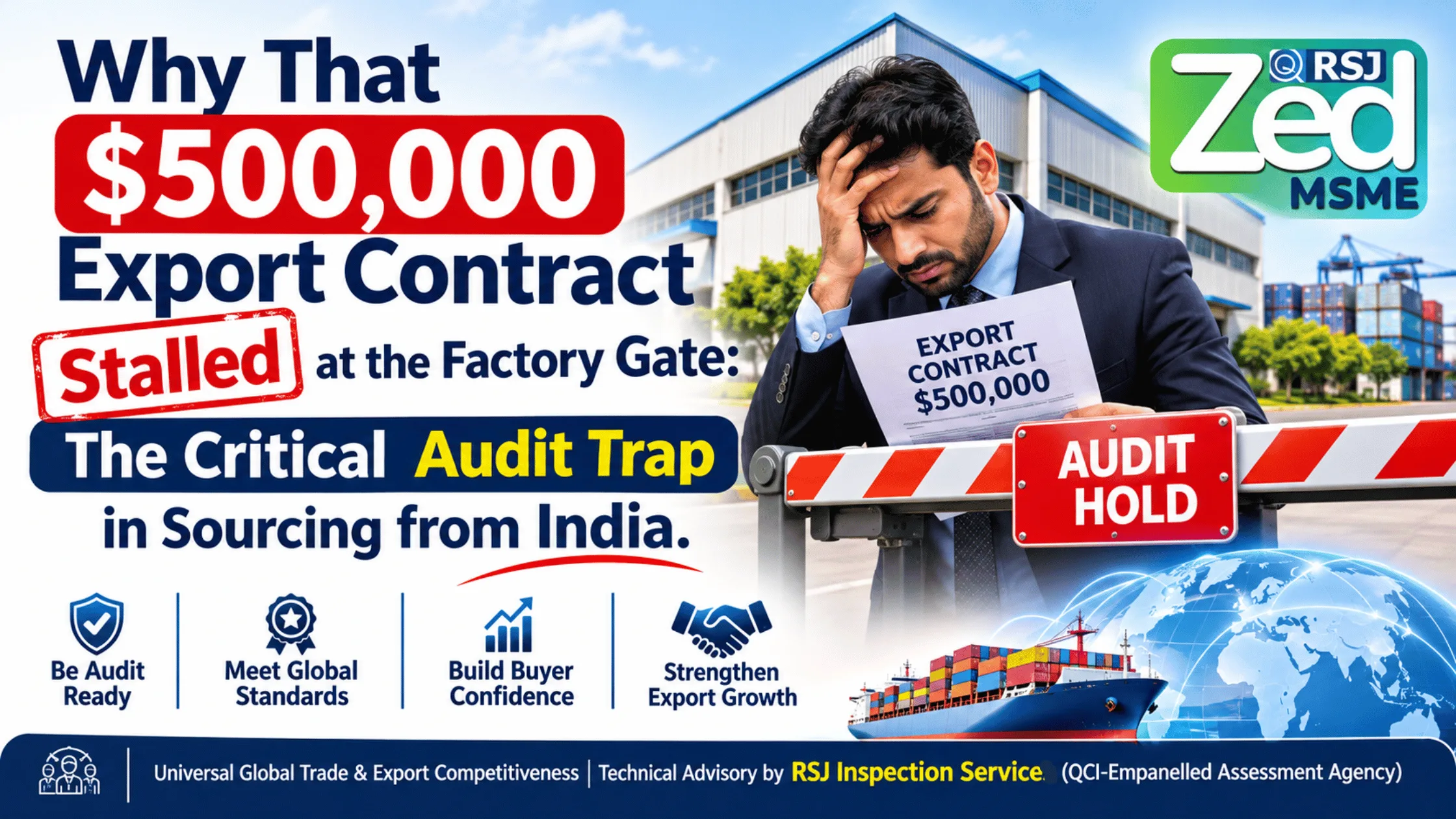
“You spent four months negotiating with a global buyer. Your component samples met preliminary specs, unit pricing was locked in, and container allocations were ready. Then came the operational condition: ‘Our corporate vendor-empanelment governance requires an accredited third-party assessment under ISO/IEC 17020 covering process capability, equipment calibration traceability, and safety before purchase order release.’ Without verified proof, the contract stalled and was reassigned to an accredited facility. Don’t let unverified systems stall your export revenue.”
1. The Reality of the Cross-Border Trust Deficit
Global supply chain directors across North America, Europe, Japan, and the Middle East are aggressively diversifying their manufacturing footprint beyond concentrated single-country sources. India is an obvious engineering and manufacturing powerhouse, boasting expansive raw-material access and skilled technical labor.
However, international sourcing heads face an immediate operational hurdle: How can a corporate board verify that an Indian factory thousands of miles away maintains disciplined process controls, calibrated measurement tools, and strict environmental compliance without spending tens of thousands of dollars on overseas audit teams?
Self-declared digital vendor profiles and basic, unaccredited certificates are no longer accepted by international procurement desks. Buyers demand standardized, third-party verified operational metrics before onboarding a new vendor.

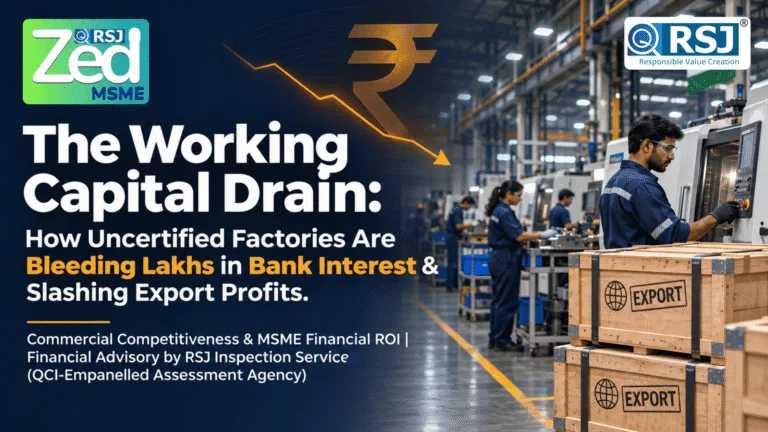
Figure 1.1: Precision CNC Shop-Floor Quality Inspection — Digital Verification of Component Tolerance & Capability.
2. The Strategic Sourcing Transition: Where Nearshoring Capital is Flowing
Rather than relying on vague market speculation, multinational supply chain diversification follows well-defined sectoral corridors:
To win long-term supply contracts against overseas competitors, Indian manufacturers must prove operational repeatability. This is where the Ministry of MSME’s ZED Certification framework bridges the credibility gap.
• India: Leading destination for precision engineering, heavy casting and forging, industrial assemblies, auto components, and sustainable textiles.
• Southeast Asia (Vietnam, Thailand, Malaysia): Fast-moving consumer goods and consumer electronics assembly.
• Mexico: Geographic nearshoring hub for North American automotive assembly under USMCA tariff benefits.
3. Silver (14 Parameters) vs. Gold (20 Parameters): Deciding Your Audit Level
Under the MSME Sustainable (ZED) Certification Scheme, implemented by the Ministry of MSME and the Quality Council of India (QCI), manufacturers can target graded certification levels designed to reflect operational maturity:
While ZED Bronze is based on an initial 5-parameter self-declaration, export-driven enterprises must advance to Silver or Gold to gain meaningful commercial credibility.
• ZED Silver Level (14 Parameters – Desktop Assessment): Evaluates foundational operational systems including Leadership, Swachh Workplace, Occupational Safety, Timely Delivery, Quality Management, HR, Daily Works Management, Maintenance & Calibration, Process Control, Testing/Certification, Material Management, Energy Management, Environment Management, and Measurement & Analysis. Ideal for domestic tier-1 vendor empanelment.
• ZED Gold Level (20 Parameters – Mandatory On-Site Physical Audit): Adds 6 advanced industrial parameters: Supply Chain Management, Risk Management, Waste Management (Muda, Mura, Muri lean principles), Technology Selection & Upgradation (Industry 4.0), Natural Resource Conservation, and Corporate Social Responsibility. Evaluated through a rigorous multi-day physical shop-floor audit conducted by an accredited third-party assessment agency under ISO/IEC 17020.
• The IAF-MLA International Shield: ZED Gold audits are performed by inspection bodies accredited by the National Accreditation Board for Certification Bodies (NABCB). Under the International Accreditation Forum (IAF) and ILAC Multilateral Recognition Arrangements (MLA/MRA), this accreditation provides reciprocal technical confidence across more than 100 countries.
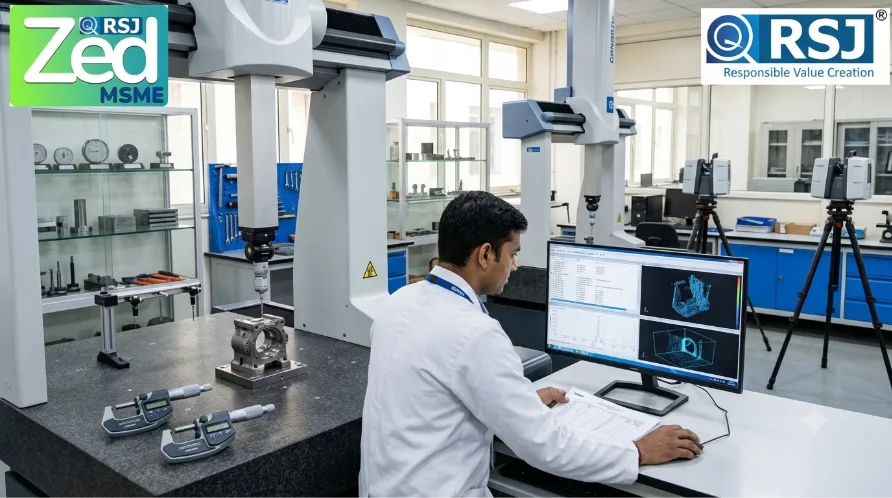
Figure 1.2: NABL-Traceable Metrology & Calibration Laboratory — Validating 100% Master Gauge Accuracy for Zero-Defect Production.
4. Supplier Evaluation: Unverified Workshop vs. ZED Gold Certified Plant
The comparison matrix below illustrates how foreign supply chain directors evaluate Indian manufacturing vendors during formal empanelment screening:
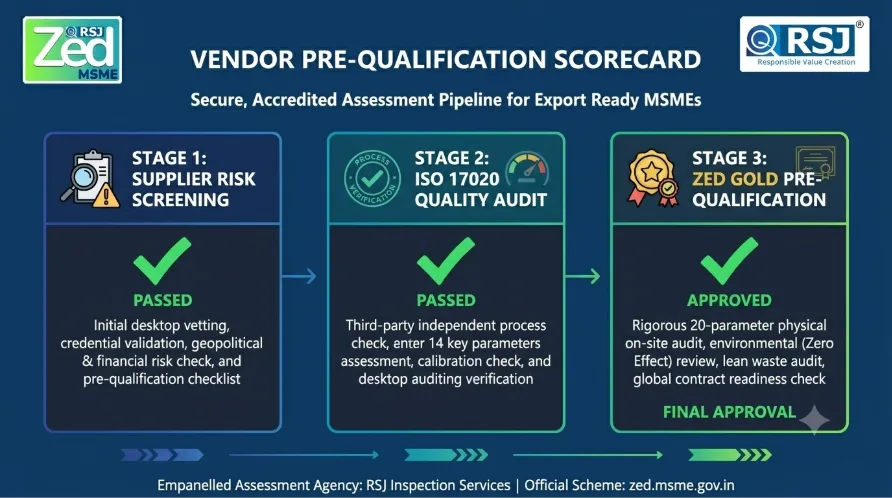
Figure 1.3: Vendor Pre-Qualification Scorecard — The Three-Stage Accredited Assessment Pipeline for Export-Ready MSMEs.
| Evaluation Parameter | Unverified Workshop | ZED Silver Plant | ZED Gold Certified Plant |
| Audit Verification | None / Unaccredited certificate | 14 Parameters (Remote Desktop) | 20 Parameters (Physical On-Site) |
| Gauge Calibration | Local expired calibration slips | Calibrated master instrument logs | 100% NABL-traceable gauge master logs |
| Risk & ESG Governance | Unmonitored energy/waste | Documented waste and energy systems | Audited waste segregation, risk & resource tracking |
| Buyer Empanelment | Rejected or limited to small trials | Empanelled for domestic supply | Fast-tracked for multi-container global export contracts |
5. Financial Subsidies & Bank Concessions for ZED Units
Achieving Silver or Gold certification is heavily supported by the Government of India and premier financial institutions:
• Certification Cost Subsidies: 80% for Micro, 60% for Small, and 50% for Medium enterprises on base certification fees (₹40,000 for Silver, ₹90,000 for Gold), plus an additional ₹10,000 joining reward.
• Banking Rate Concessions: Leading banks (including SBI, Bank of Baroda, and ICICI Bank) offer 0.25% to 0.50% interest rate concessions and up to 50% processing fee waivers on working capital facilities for ZED-certified units.
• International Market Support: Under the MoMSME International Cooperation (IC) Scheme, certified exporters qualify for stall space rent reimbursement up to ₹3.00 Lakh and economy airfare reimbursement up to ₹1.50 Lakh at approved global expos.
Accelerate Your ZED Assessment with RSJ Inspection Services
Don’t risk delayed export contracts or failed customer audits. RSJ Inspection Services is an accredited ISO/IEC 17020 third-party inspection agency empanelled under the Quality Council of India (QCI) to conduct authoritative ZED assessments across India. Contact our assessment team to initiate your Silver or Gold audit readiness review.
Official Assessment & Scheme Verification Portals:
• RSJ ZED MSME Portal: https://zedmsme.com/
• RSJ Corporate QA & Audit Desk: https://rsjqa.com/
• MoMSME Official Scheme Portal: https://zed.msme.gov.in/